Sound comes along
Audio follows the picture to the second Mac's speakers, in sync with the frame it belongs to.
One app · One cable · Full resolution
DisplayBridge sends one Mac's screen to another over a single Thunderbolt cable. The whole 5120 × 2880 at 60 Hz on a Retina 5K iMac, 120 Hz on a recent MacBook Pro.
7-day free full trial · no account · no credit card · macOS 13 or newer · Thunderbolt 3 or higher
Setup
No host app and viewer app, no accounts, no IP addresses to type. The same 6 MB download goes on both Macs, and either one of them can be the screen.
One app, 6 MB. The same file goes on the Mac you work on and the Mac you want to use as a screen.
No account, no sign-in, nothing to set up. Just open it on each of the two Macs.
One Thunderbolt cable, directly between the two Macs. macOS brings the connection up on its own.
Each Mac already lists the other. One click, and the second screen is live.
The Mac receiving the picture is free, forever — only the Mac sending its screen needs a license.
The film
What it is, what it needs, and how the second Mac lights up. Watch it before you download — it is the whole product.
The app
One window, on both Macs. It shows what is connected, how well it is running right now, and the two sliders you would otherwise walk around the desk for. There is no second window, no preferences maze, no dashboard.
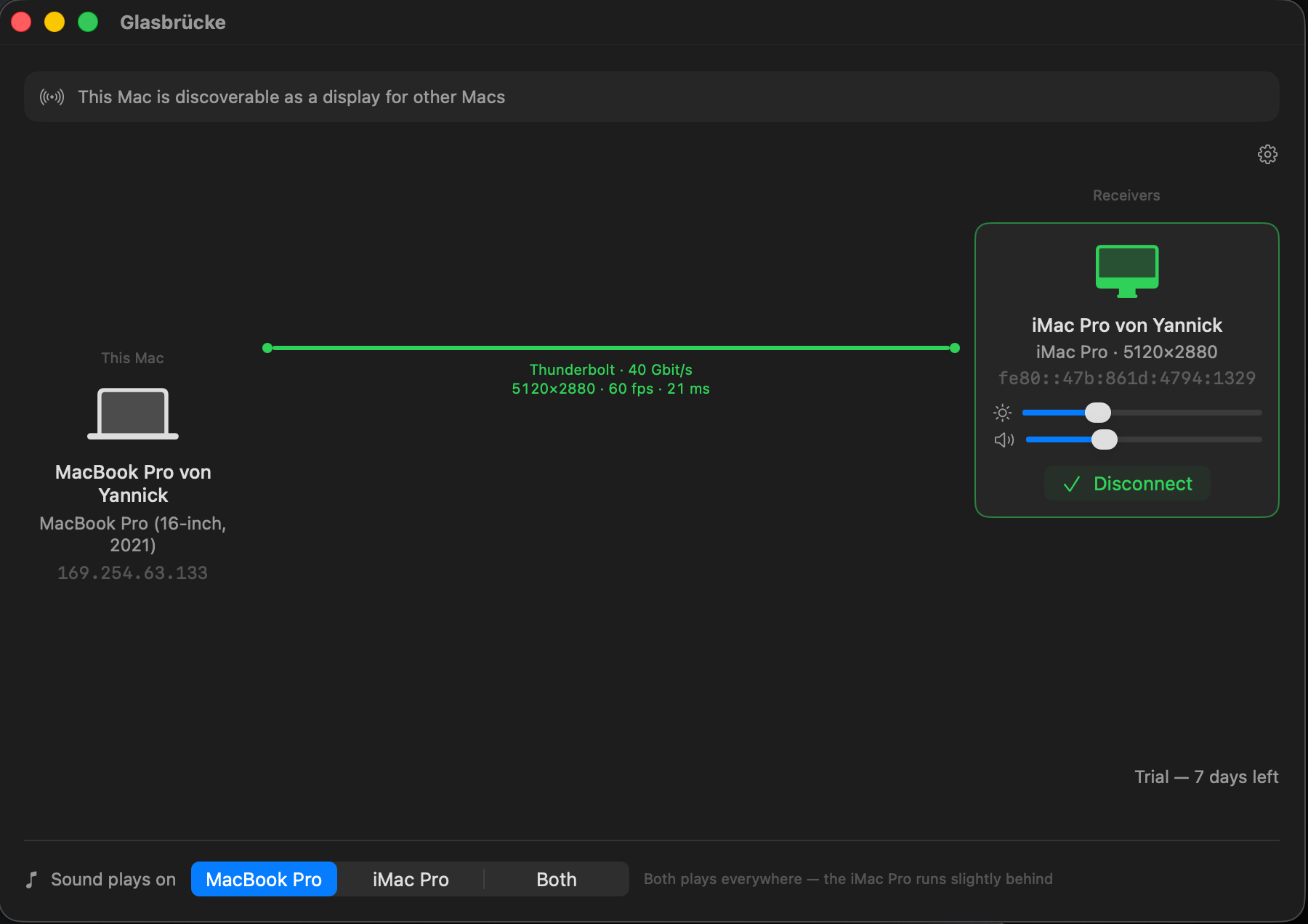
Audio follows the picture to the second Mac's speakers, in sync with the frame it belongs to.
Brightness and volume of the second Mac sit on the streaming card of the first. You never walk around the desk.
Dual 5K at 60 Hz from a single MacBook Pro, on two separate cables, both at full resolution.
No login item, no background agent, no menu bar clutter you did not ask for. Quit it and it is gone.
Built with the frameworks macOS already ships. Universal binary, back to macOS 13 on Intel and Apple silicon.
No resolution lists, no transport pickers, no diagnostics tab. It finds the cable and uses it.
Privacy
Your screen travels down the Thunderbolt cable between your two Macs and stops there. It never touches the internet, our servers, or anyone else's — there is no cloud in this product to send it to. Nothing you do on that screen is recorded, stored, or transmitted, and there is no account to create in the first place.
Requirements
Sending a full 5K picture sixty times a second is roughly 10.6 Gbit/s of data. Thunderbolt is the only cable on a Mac that carries that much. That single restriction is what buys you the whole picture — and a connection that behaves the same on the hundredth day as on the first.
Questions
No. The Mac that shows the picture never needs a license — that is the point of shipping one app instead of two. Only the Mac sending its screen is licensed, and one license covers three of them.
No, and it never will. A full 5K picture at 60 Hz is about 10.6 Gbit/s. Wi-Fi and Gigabit Ethernet are one to two orders of magnitude short of that, so anything wireless has to throw most of the picture away to fit. We would rather ship one path that always works than four that sometimes do.
A Retina 5K iMac from 2017 or later. That is also the oldest iMac Apple still gave macOS 13 Ventura to, so the two requirements line up. Other Macs work fine as displays — they simply run at their own native resolution instead of 5K.
License
Try everything for seven days first — no card, no account. A license is then $29 one time and covers up to three of your Macs; every receiving Mac stays free.
7-day full trial · macOS 13+ on both Macs · one Thunderbolt cable